Saturday, August 06, 2005

What's on the web today

The NY Times reports today that some bombs used in Iraq are made in Iran, U.S. says. Here's an excerpt:

WASHINGTON, Aug. 5 - Many of the new, more sophisticated roadside bombs used to attack American and government forces in Iraq have been designed in Iran and shipped in from there, United States military and intelligence officials said Friday, raising the prospect of increased foreign help for Iraqi insurgents.

American commanders say the deadlier bombs could become more common as insurgent bomb makers learn the techniques to make the weapons themselves in Iraq.

One hopes vain that someday this government will wake up to the fact that we are at war with Iran and act accordingly.

**

Victor Davis Hanson writes about the 60th anniversary of the bombing of Hiroshima.

Americans of the time hardly thought the Japanese populace to be entirely innocent. The Imperial Japanese army routinely butchered civilians abroad — some 10-15 million Chinese were eventually to perish — throughout the Pacific from the Philippines to Korea and Manchuria. Even by August 1945, the Japanese army was killing thousands of Asians each month. When earlier high-level bombing attacks with traditional explosives failed to cut off the fuel for this murderous military — industries were increasingly dispersed in smaller shops throughout civilian centers — Curtis LeMay unleashed napalm on the Japanese cities and eventually may have incinerated 500,000.

In order to win the present war it will be necessary to adopt the same attitude toward the country of Iran (and others) as was held during WWII toward Japan.

Friday, August 05, 2005

What's on the web today

Thursday, August 04, 2005

Lincoln the fatalist

While I'm continuing to read Carl Sandburg's biography of Abraham Lincoln, I came across this interesting statement, published by Lincoln in response to attacks on him by Christian critics:

"FELLOW CITIZENS:
"A charge having got into circulation in some of the neighborhoods of this District, in substance that I am an open scoffer at Christianity, I have by the advice of some friends concluded to notice the subject in this form. That I am not a member of any Christian Church, is true; but I have never denied the truth of the Scriptures; and I have never spoken with intentional disrespect of religion in general, or any denomination of Christians in particular. It is true that in early life I was inclined to believe in what I understand is called the "Doctrine of Necessity" -- that is, that the human mind is impelled to action, or held in rest by some power, over which the mind itself has no control; and I have sometimes (with one, two or three, but never publicly) tried to maintain this opinion in argument. The habit of arguing thus however, I have, entirely left off for more than five years. And I add here, I have always understood this same opinion to be held by several of the Christian denominations. The foregoing, is the whole truth, briefly stated, in relation to myself, upon this subject.
"I do not think I could myself, be brought to support a man for office, whom I knew to be an open enemy of, and scoffer at, religion. Leaving the higher matter of eternal consequences, between him and his Maker, I still do not think any man has the right thus to insult the feelings, and injure the morals, or the community in which he may live. If, then, I was guilty of such conduct, I should blame no man who should condemn me for it; but I do blame those, whoever they may be, who falsely put such a charge in circulation against me." -- Handbill Replying to Charges of Infidelity, 31 July 1846 (copied from here)
So it would seem that Lincoln while not being particularly religious was something of a determinist. Of course determinism in the guise of predestination was always a feature within Christianity, which continues to struggle with the implications this poses to the existence of free will. One wonders if Lincoln got his determinism directly out of Christianity or out of reading some secular philosophers. It seems to be the former.
What's on the web today...

I browse several dozen news, opinion, blogs and other websites every day. Here's what I found of broader interest today:

Mark Steyn writes eloquently in a column entitled The etiquette of modern warfare in today's Jerusalem Post:

...an enemy folds when he knows he's finished. In Iraq, despite the swift fall of the Saddamites, it's not clear the enemy did know. Indeed, the western peaceniks pre-war "human shields" operation proved to be completely superfluous mainly because the Anglo-American forces decided to treat not just Iraqi civilians and not just Iraqi conscripts but virtually everyone other than Saddam, Uday and Qusay as a de facto human shield. Washington made a conscious choice to give every Iraqi the benefit of the doubt, including the fake surrenderers who ambushed the US marines at Nasiriyah.

In happier technological news Akio Namiki and colleagues at the University of Tokyo, Japan have built a Robot catcher grabs high speed projectiles, as reported by Newscientist. See the video (about 9 MB) -- it's pretty cool.

On the Ayn Rand Institute's web site I am pleased to see that a couple of new local (to Irvine, California) public lectures have been announced:

Monday, September 12, 2005, Free Public Lecture (title TBD) By Yaron Brook
Thursday, November 17, 2005, Creationism in Camouflage: The "Intelligent Design" Deception By Keith Lockitch
Time: 6:30 PM: Bookstore opens, 7:30 PM: Lecture, 8:30 PM: Q & A
Location: Hyatt Regency Irvine 17900 Jamboree Rd. Irvine, CA 92614

Wednesday, August 03, 2005

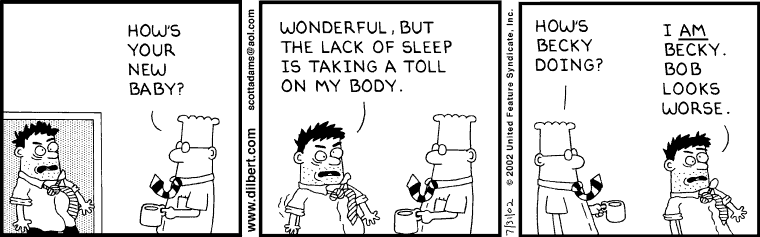
More baby blues
Click on the Dilbert comic below for more detail.

Tuesday, August 02, 2005

With the birth of a newborn comes sleeplessness. So far my son still mostly wakes up every 2 hours and that means my wife and I wake up as well. At least I'm only working half-days this week.

There are all sorts of books on my list to read, many of which I own already. Presently, I'm trying to finish Carl Sandburg's Abraham Lincoln. I acquired it within the last two years when I noticed it among the special value hard covers at the local Borders Bookstore, but I've only started reading it recently. So far I'm about 80 pages into it. Lincoln's early years certainly make plain the humble background in which he grew up. He engaged in lots of manual labor. At one point he even was a wrestler. At this point in the book he is still a young lawyer with some political connections with the Whigs. I am not yet particularly impressed with him. He has so far supported legal measures that I would be opposed to such as tariffs. Nevertheless, I'm looking forward to further reading and hope to acquire a more detailed knowledge of the Civil War period, of which I am ignorant in many ways.

Saturday, July 30, 2005

On a personal note...

My son was born July 23, 2005 at 12:26am. Here's a link to brief album of photographs.

Friday, June 17, 2005

Europe and the Nihilism of Intellectuals

In a fascinating article (registration required) in today's (June 17, 2005) Wall Street Journal, author Paul Johnson presents his analysis of What Europe Really Needs. He begins by describing the problem:

That Europe as an entity is sick and the European Union as an institution is in disorder cannot be denied. But no remedies currently being discussed can possibly remedy matters.
...
The fundamental weaknesses of the EU that must be remedied if it is to survive are threefold. First, it has tried to do too much, too quickly and in too much detail.
...
The EU's economic philosophy, insofar as it has one, is epitomized by one word: "convergence." The aim is to make all national economies identical with the perfect model. This, as it turns out, is actually the perfect formula for stagnation.


Of course, the European bureaucracy and attempt at a successful mixed economy (with equal parts of capitalism and socialims) are fairly well known. Even Sweden, which used to be held up as a model welfare state, is now seen to be less than ideal (for example, see this op-ed in the Washington Times). Johnson also mentions rising anti-Semitism and anti-Americanism as part of the problem. Less well understood is the third point that Johnson makes:


There is another still more fundamental factor in the EU malaise. Europe has turned its back not only on the U.S. and the future of capitalism, but also on its own historic past. Europe was essentially a creation of the marriage between Greco-Roman culture and Christianity. Brussels has, in effect, repudiated both.
...
Equally, what strikes the observer about the actual workings of Brussels is the stifling, insufferable materialism of their outlook.
...
The EU has no intellectual content. Great writers have no role to play in it, even indirectly, nor have great thinkers or scientists.

Note that Johnson observes that both Christianity and Philosophy (described as "Greco-Roman culture") has been rejected. He does not explain what led to the rejection. But the answer is known to all who have read Dr. Leonard Peikoff's book The Ominous Parallels -- the answer lies in the philosophical trend that led to the present intellectual milieu. Great writers were once admired because they expressed profound views on the important issues in life whether directly through philosophical writings or indirectly through art. Unfortunately, today's intellectuals reject any attempt at greatness or importance as a result of the explicit nihilism that they have adopted. It does not matter to them whether the greatness is religious or secular. That nihilism can be seen in the form of multiculturalism and environmentalism, two ideologies that are fundamentally destructive of all values, spiritual and material.

Thursday, May 19, 2005

History vs. Philosophy

In a fascinating column in the Washington Post of Thursday, May 19, 2005, George Will presents and supports Donald Kagan's case for history as the "queen of the humanities." Will argues for "moderation" between the two sides in the current culture wars. Arguing that the study of history presents an alternative as against both postmodern denial of objectivity and religious reliance on faith, Will writes:

Historians, however, say to the post modernists that the defining characteristics of postmodernism -- skepticism and cynicism -- have long histories. And the historians' riposte to those who say that religion is the only foundation for knowledge or virtue is, Kagan says, to insist that in the study of history, knowledge, far from impossible, is cumulative.


How does the fact that some view has "long histories" constitute an argument against it? This is not explained but on religion Will adds quoting Kagan:

"Religion and the traditions based on it were once the chief sources for moral confidence and strength. Their influence has faded in the modern world, but the need for a sound base for moral judgments has not. If we cannot look simply to moral guidance firmly founded on religious precepts it is natural and reasonable to turn to history, the record of human experience, as a necessary supplement if not a substitute."

Will also quotes Kagan's view of how philosophy rates below history:

All writers of history have "the responsibility of preserving the great, important and instructive actions of human beings," says Kagan, which is why history is "the queen of the humanities," ranking above literature and even philosophy.

Philosophy, he says, is valuable for untangling sloppy thinking. But philosophy, like religion, leads to investigations of first principles and ultimate reality, and such investigations have produced profound disagreement. Hence the primacy of history as the study from which, especially today, we can take our moral bearings[.]


Is philosophy's only purpose "untangling sloppy thinking"? If there are and continue to be philosophical disagreeements, are there not historical disagreements as well?

Even a superficial reading of Will's column raises some of the questions that I have listed above. I sympathize with George Will's intention, to find a "firm middle, or perhaps higher, ground for moral confidence" and knowledge of history certainly has to play a part in a rational, sensible approach to morality. But knowledge of history is not enough. For the last few centuries science has prided itself on the claim that it is "value-free." Thus modern science, whether natural or social, is descriptive, not prescriptive. As such, even accurate knowledge of historical events does not prescribe any actions in the present, nor does it, strictly speaking, evaluate the actions of the past. It mere recounts them. Of course various historians as well as other scientists have applied value judgments to their researches. But such normative conclusions depend on the philosophical as well as religious views of the person and as their values vary so do their normative conclusions.

This goes back to the fundamental issue in attempting to form any ethics. How does one bridge fact and value? I know for a fact that Colonial America won its independence from the King, I know that NAZI Germany was defeated by the allies, I know that the Romans conquered much of the ancient world, I know that the fall of Rome was followed by the Middle Ages, the first part of which is usually termed the Dark Ages. So what? How does any of this lead me to any ethical conclusions without prior ethical knowledge? Of course, it cannot. Certainly it can form part of the raw data to be used in reaching ethical conclusions but something else is needed to reach it.

The answer has to be philosophy. Within the so-called Judeo-Christian tradition it is God as the creator of all, who has revealed the commandments of right and wrong that you must obey. Using God's commandments one can then, to some extent, evaluate historical events as good and bad. Since religion's decline beginning in the 18th century, various attempts have been made to bridge the gap in a non-religious way. Usually, this meant some form of collectivism substitutes for God: Society has decreed what is right and what is wrong. With the massive apparent failures of various collectivisms in the 20th century, philosophers have begun to deny that ethics is anything other than an emotive expression. In other words, this is wrong because we feel it is wrong. My feeling constitutes my evaluation as well as my justification.

It is no wonder that given the current state of philosophy that many people seek a return to the apparent sense and stability of religious values. But they are mistaken, a proper approach to morality must rely on the application of reason and science to human affairs because there is no such thing as the supernatural and thus all attempts to base morality on it are doomed to failure. Morality must begin with an analysis of what values are and why man needs them, not midstream with moral intuitions. The analysis must rely on a proper understanding of the nature of conceptual knowledge and its objectivity, as well as an understanding of the basic nature of the world and man. Such an analysis has been done superlatively by 20th century novelist-philosopher Ayn Rand. The result is a radically new approach to the whole subject of morality, one that provides the first objective code of values and virtues that man must follow if he is live his life as a rational being.

Saturday, February 05, 2005

The prediction...

One of the interesting things about reading the Ayn Rand Journals a few years ago and many years after first reading the Fountainhead, was the realization that the various seemingly absurd statements made by the various irrational architects in the book were not exaggerations but were taken straight from her research into the profession.

I am presently rereading the Fountainhead and I ran across this interesting paragraph:

"Jules Fougler said in last Sunday's Banner that in the world of the future the theater will not be necessary at all. He says that the daily life of the common man is as much a work of art in itself as the best Shakespearean tragedy. In the future there will be no need for a dramatist. The critic will simply observe the life of the masses and evaluate its artistic points for the public. That's what Jules Fougler said. Now I don't know whether I agree with him, but he's got an interesting fresh angle there."

It seems that here we have a prediction for the unfortunate phenomena that for the past few years has been making the rounds of the television program schedules: Reality TV. It was predicted by Ayn Rand in The Fountainhead over 60 years ago.

Monday, November 08, 2004

The Election: Values vs. Terrorism

In light of my previous comments on the role played by religious values in this election, it is important to point out that at least two sources have been interpreting the statistical evidence coming out of the exit polls quite differently. Paul Freedman of the liberal online magazine Slate offers the following analysis in a column entitled "The Gay Marriage Myth: Terrorism, not values, drove Bush's re-election":

More to the point, the morality gap didn't decide the election. Voters who cited moral issues as most important did give their votes overwhelmingly to Bush (80 percent to 18 percent), and states where voters saw moral issues as important were more likely to be red ones. But these differences were no greater in 2004 than in 2000. If you're trying to explain why the president's vote share in 2004 is bigger than his vote share in 2000, values don't help.

If the morality gap doesn't explain Bush's re-election, what does? A good part of the answer lies in the terrorism gap. Nationally, 49 percent of voters said they trusted Bush but not Kerry to handle terrorism; only 31 percent trusted Kerry but not Bush. This 18-point gap is particularly significant in that terrorism is strongly tied to vote choice: 99 percent of those who trusted only Kerry on the issue voted for him, and 97 percent of those who trusted only Bush voted for him. Terrorism was cited by 19 percent of voters as the most important issue, and these citizens gave their votes to the president by an even larger margin than morality voters: 86 percent for Bush, 14 percent for Kerry.

Another commentator offering a similar view is David Brooks, a NY Times columnists. In his column entitled "The Values-Vote Myth," he writes (free registration required to read the NYT article, the article may eventually not be freely available):

Much of the misinterpretation of this election derives from a poorly worded question in the exit polls. When asked about the issue that most influenced their vote, voters were given the option of saying "moral values." But that phrase can mean anything - or nothing. Who doesn't vote on moral values? If you ask an inept question, you get a misleading result.

The reality is that this was a broad victory for the president. Bush did better this year than he did in 2000 in 45 out of the 50 states. He did better in New York, Connecticut and, amazingly, Massachusetts. That's hardly the Bible Belt. Bush, on the other hand, did not gain significantly in the 11 states with gay marriage referendums.

He won because 53 percent of voters approved of his performance as president. Fifty-eight percent of them trust Bush to fight terrorism. They had roughly equal confidence in Bush and Kerry to handle the economy. Most approved of the decision to go to war in Iraq. Most see it as part of the war on terror.


Well, this is certainly good news. If these analyses are true then the majority of people who helped elect Bush did so because they thought he would be better at fighting the war, rather than as some kind of effort to impose religious values (for which there really wasn't that much evidence to begin with, at least so far).

With the present effort in Fallujah underway (Operation "Phantom Fury") I would like to remain optimistic, at least for a while, and await what the administration will do with respect to domestic and foreign policy. I suppose there really isn't a very good reason to expect drastic differences but at this point I'm inclined to give Bush the benefit of the doubt.

Friday, November 05, 2004

The Election Results: Implications & the War

I was happy to be proven right in the results of the elections, having predicted a little after the Democratic National Convention that the Kerry would lose. I admit to being a little worried by the constant media references to a "close race" but in the end I just could not believe that the majority of the American people were so dissatisfied with Bush as to elect somebody with the kind of history that Kerry had and positions that Kerry held throughout his Senate career. Actually that would have required more than dissatisfaction. It would have required the majority of this country to abandon its basic fighting spirit. And I just didn't think that would happen. While ultimately this is irrelevant, I admit to liking President Bush on a personal level much more than Senator Kerry. Despite many things that I think are wrong with President Bush, there is far more to respect about him than there ever was about Senator Kerry and that is part of the reason why I voted for Bush.

Of course, Kerry did not run his campaign as a leftist pacificist and Bush lacks much of the fighting spirit necessary to inspire a much clearer majority but nevertheless, for me at least that's what this election was about.

The media is presently reporting that according to exit polls "moral values, such as abortion" was the most important issue for the largest fraction (22%) of the electorate, with terrorism at 19%. This is a depressing statistic and is another piece of evidence confirming the increasing religious trend in this country that Dr. Peikoff detailed in his DIM Hypothesis Lectures. In fact, if Kerry had won I would have considered that evidence against Peikoff's view that the religious trend is increasing. However, before we get too alarmist I think this hopeful explicit statement on the issue from President Bush himself during his recent press conference needs to be taken into account:

Q Mr. President, your victory at the polls came about in part because of strong support from people of faith, in particular, Christian evangelicals and Pentecostals and others. And Senator Kerry drew some of his strongest support from those who do not attend religious services. What do you make of this religious divide, it seems, becoming a political divide in this country? And what do you say to those who are concerned about the role of a faith they do not share in public life and in your policies?

THE PRESIDENT: Yes, my answer to people is, I will be your President regardless of your faith, and I don't expect you to agree with me necessarily on religion. As a matter of fact, no President should ever try to impose religion on our society.

A great -- the great tradition of America is one where people can worship the way they want to worship. And if they choose not to worship, they're just as patriotic as your neighbor. That is an essential part of why we are a great nation. And I am glad people of faith voted in this election. I'm glad -- I appreciate all people who voted. I don't think you ought to read anything into the politics, the moment, about whether or not this nation will become a divided nation over religion. I think the great thing that unites is the fact you can worship freely if you choose, and if you -- you don't have to worship. And if you're a Jew or a Christian or a Muslim, you're equally American. That is -- that is such a wonderful aspect of our society; and it is strong today and it will be strong tomorrow.

The above is a far better statement on this issue than that given by President Bush's father who did not seem to think that atheists really have a place in this country. Particularly as an Objectivist who believes that objective moral values, far from relying on religion, in fact come from recognizing the nature of man and his relation to this world, it is reassuring to hear the President proclaim that we can be "just as patriotic." I hope that this will not turn out to be idle rhetoric.

Now for the war. Here I think it is Bush's weaknesses that have been the primary reason why the race was so close. I came across a transcript of a fascinating lecture by Victor Davis Hanson called "What Would Patton Say About the Present War?" For me the money passage is the following:

But Patton would insist that it is only by military defeat and subsequent humiliation first that the supporters of terrorism against the West will understand the wages of their support for Islamic fascism. Once people in the Middle East, like the Germans, see that the Islamic fascists are defeated - and that all who support and condone that ideology are synonymous with it and thus must pay for their complicity through some measure of sacrifice and suffering - radical bellicose Islamicism really will end. Patton was quite clear about defeating, humiliating and then helping Germans - the proper order of such a progression in attitude being absolutely critical.
[Emphasis added]

I am heartened by the fact that a Conservative like Hanson understands the lesson that Patton taught. This is the kind of point that Dr. Peikoff and ARI Director Dr. Yaron Brook have been making in their recent speeches and lectures. Unfortunately the Bush administration seems to be operating under a different principle as illustrated by the following quote from the recent press conference:

Q Thank you, Mr. President. On foreign policy, more broadly, do you believe that America has an image problem in the world right now, because of your efforts and response to the 9/11 attacks? And, as you talked down the stretch about building alliances, talk about what you'll do to build on those alliances and to deal with these image problems, particularly in the Islamic world.

THE PRESIDENT: I appreciate that. Listen, I've made some very hard decisions: decisions to protect ourselves, decisions to spread peace and freedom. And I understand in certain capitals and certain countries, those decisions were not popular.
You know, you said -- you asked me to put that in the context of the response on September the 11th. The first response, of course, was chasing down the terror networks, which we will continue to do. And we've got great response around the world in order to do that. There's over 90 nations involved with sharing information, finding terrorists and bringing them to justice. That is a broad coalition, and we'll continue to strengthen it.

I laid out a doctrine, David, that said if you harbor terrorists, you're equally as guilty as the terrorists, and that doctrine was ignored by the Taliban, and we removed the Taliban. And I fully understand some people didn't agree with that decision. But I believe that when the American President speaks, he'd better mean what he says in order to keep the world peaceful. And I believe we have a solemn duty, whether or not people agree with it or not, to protect the American people. And the Taliban and their harboring of al Qaeda represented a direct threat to the American people.

And, of course, then the Iraq issue is one that people disagreed with. And there's no need to rehash my case, but I did so, I made the decision I made, in order to protect our country, first and foremost. I will continue to do that as the President. But as I do so, I will reach out to others and explain why I make the decisions I make.

There is a certain attitude in the world, by some, that says that it's a waste of time to try to promote free societies in parts of the world. I've heard that criticism. Remember, I went to London to talk about our vision of spreading freedom throughout the greater Middle East. And I fully understand that that might rankle some, and be viewed by some as folly. I just strongly disagree with those who do not see the wisdom of trying to promote free societies around the world.

If we are interested in protecting our country for the long-term, the best way to do so is to promote freedom and democracy. And I -- I simply do not agree with those who either say overtly or believe that certain societies cannot be free. It's just not a part of my thinking. And that's why during the course of the campaign, I was -- I believe I was able to connect, at least with those who were there, in explaining my policy, when I talked about the free election in Afghanistan.

There were -- there was doubt about whether or not those elections would go forward. I'm not suggesting any of you here expressed skepticism. But there was. There was deep skepticism, and -- because there is a attitude among some that certain people may never be free -- they just don't long to be free or incapable of running an election. And I disagree with that. And the Afghan people, by going to the polls in the millions, proved -- proved that this administration's faith in freedom to change peoples' habits is worthy. And that will be a central part of my foreign policy. And I've got work to do to explain to people about why that is a central part of our foreign policy. I've been doing that for four years.

But if you do not believe people can be free and can self-govern, then all of a sudden the two-state solution in the Middle East becomes a moot point, invalid. If you're willing to condemn a group of people to a system of government that hasn't worked, then you'll never be able to achieve the peace. You cannot lead this world and our country to a better tomorrow unless you see a better -- if you have a vision of a better tomorrow. And I've got one, based upon a great faith that people do want to be free and live in democracy.


The best part of the president's strategy is his statement "if you harbor terrorists, you're equally as guilty as the terrorists." The worst part derives from his continued insistence on referrring to the enemy as "terrorism." As Victor Hanson has stated:

Applying Patton's thinking to today's situation, we can first recognize the so-called "war on terror" as a misnomer. There has never really been a war against a method other than something like Pompey's crusade against the pirates or the British effort to stifle the slave trade. In fact, we're no more in a war against terror than Patton was fighting against Tiger and Panzer tanks. Patton, who understood the hold of a radically triumphalist Nazism on a previously demoralized German people, would have the intellectual honesty to realize that we are at war with Islamic fascists, mostly from the Middle East, who have played on the frustrations of mostly male, unemployed young people, whose autocratic governments can't provide the conditions for decent employment and family life. A small group of Islamists appeals to the angst of the disaffected through a nostalgic and reactionary turn to a mythical Caliphate, in which religious purity trumps the material advantages of a decadent West and protects Islamic youth from the contamination of foreign gadgetry and pernicious ideas. In some ways, Hitler had created the same pathology in Germany in the 1930s.

The refusal by Bush to name the enemy severely constrains his actions. It implies that if only the few terrrorists and their immediate supporters go away, the enemy will be defeated. However, a recognition that the enemy is ideologically driven would imply that while the present violent representatives of the ideology must be killed or captured, the basis for any belief in the ideological goals must be completely destroyed. This is the "humiliation" that Hanson argued Patton thought necessary. And unfortunately it seems to be largely missing from our strategy.

Next I would criticise Bush's "faith in freedom." The issue is not that I believe that there's some inherent biological reason why people in the Middle East cannot be free. The issue is again, ideological. If freedom, as we understand the term, is not a value to people due to their own beliefs then they will neither seek nor accept it. This is the Libertarian mistake -- to assume that everybody would really support liberty and that no specific moral ideas are necessary to ground it. But liberty as we understand it is a completely different idea from freedom as an Islamic Fundamentalist would hold, or a Nazi or a Communist. It is not a self-evident idea. It is an intellectual achievement that the West took centuries to reach. To assume that the culture of the Middle East is such as to be presently conducive to freedom as we understand the term, is to admit one's ignorance of that culture. The fact that man needs freedom (properly understood) in order to live and live well, does not mean that any given man understands that. And in the Middle East in particular, with its numerous irrational and barbarous religious and tribal traditions, and conspiracy mentality the problem of introducing rule of law, individual rights and representative governments is a daunting one indeed. It would be helped if the existing ideas had at least been discredited and if we properly understood, were confident about, and propagated our own ideas and political system, something which has not been the case so far.

It is hoped that the Bush administration will be more agressive in its war strategy in its second term, though in some ways this is doubtful. If as Dr. Brook has argued, the administration is guided by Just War theory (for details, see here and here), then it is likely that the war will continue to be pursued by less than fully effective means. It is also hoped that we will target Iran next, an action, which as Scott Holleran has pointed out, is 25 years overdue. It remains to be seen what the administration will do. Perhaps it will surprise us.

Tuesday, October 19, 2004

American Soldier

Today I finished listening to American Soldier -- General Tommy Franks Autobiography. I highly recommend it for many reasons. General Franks overall life story is quite inspiring. He comes across as very much American -- in the best sense of the word: A man with a strong sense of justice, a curious, active mind, a thinker and a doer. His experiences in the Vietnam War provide a good backdrop to his later leadership roles. I thought he became somewhat more political (and hence more compromising) in his later years but I think here he is no different than most his contemporaries. His strategy of relying on high-technology to achieve great advantages in speed and maneuver was militarily successful in both the Afghanistan and Iraq wars, though the conclusion of the Iraqi aftermath is yet to be written. All in all he appears to best among the best of the current crop of leaders this country possesses.

Thursday, October 14, 2004

Wars, Facts on the Ground, and Interpretations

I came across two descriptions of what's going on in Iraq at the moment. An article featuring numerous interviews with marines and soldiers in Iraq offers a pessimistic assessment in the Washington Post (free registration required -- the article is from Oct. 10 and may not be available forever) and was featured in the most recent issue of Scott Holleran's Concord Crier. Here's a few revealing excerpts from the article:

"Sometimes I see no reason why we're here," [Lance Cpl. Carlos] Perez said. "First of all, you cannot engage as many times as we want to. Second of all, we're looking for an enemy that's not there. The only way to do it is go house to house
until we get out of here."
...
"Every day you read the articles in the States where it's like, 'Oh, it's getting better and better,' " said Lance Cpl. Jonathan Snyder, 22, of Gettysburg, Pa. "But when you're here, you know it's worse every day."
...
Lance Cpl. Jeremy Kyrk, 21, of Chicago, said the insurgents took advantage of the limitations imposed on U.S. troops. "They don't give us any leeway, they don't give us any quarter," he said. "They catch people and cut their heads off. They know our limits, but they have no limits. We can't compete with that."

Read the whole article -- it will not make you optimistic about the future in Iraq. Still, I also came across a commentary written by Joe Kane, who is with the US Navy and stationed in Baghdad, his blog Able Kane Adventures. Ironically, Joe was commenting on another article in similar vein to the WP article mentioned above. Joe grants that the facts do not look particularly great at the moment but he writes:

I don’t think this is going to be a pretty or clean victory. Nor will it be a short battle. There is a lot of complexity and very little understanding. We, the Americans will do things bit by bit, stepping forward and back, and making our way through this seeming minefield of confusion and some great things will be done while some great opportunities will be missed. In the end, I can point you to one of my earliest blog entries about my outlook for Iraq. Whenever I get confused or discouraged by things this refreshes me and puts me back on track.

“This will be primarily a war of ideologies, and it is inevitable that we win. I just flew over the rooftops of downtown Baghdad and what do you think I saw? A lot of poverty, overheated heaps of garbage, small herds of goats and sheep among dried vegetation, burned and bombed out cars and half-naked children gazing up from mud-brick walls.

I also saw cell phone towers, and most importantly I saw satellite dishes. Shining disks, perfectly round, straining like great aluminum flowers toward an unseen sun of free-flowing information orbiting the equator, bringing light into minds as surely as the other sun brings daylight into the cold of the desert night. These are the weapons of freedom. These are the destroyers of tyranny.

No amount of tyranny can stand against people who are free to engage in the trafficking of ideas. That is why our first amendment is protected and fought over so fiercely at home, and ultimately, if you want to understand the American soul you can look back over our history of arguing and fighting and dying for that very thing - the right to speak your mind regardless of what anyone else might think of it.

Again, read the whole entry in Joe's blog -- it is instructive and will give you some hope for the future. I'm not sure which is right. Generally speaking I lean more to the pessimistic side as can be seen by some of my previous posts but it's good, in this case, to know that there's a chance I'm wrong.

Tuesday, October 12, 2004

Objectivism & "the Right"

Brad Malestein of Contemporary History has written a provocative essay entitled "Objectivism is Not Part of 'The Right'". Brad argues that TIA editor Robert Tracinski's is mistaken in his recommendation to create a "secular right." Brad writes:

What Mr. Tracinski proposes can only result in confusion and disaster. The confusion would result from the package-deal of putting Objectivism, a pro-reason, pro-egoism philosophy, under the same concept, The Right, as religious groups and pragmatist conservatives. The disaster would come in the form of Objectivists wasting untold effort combatting the package-deal, especially since it would be Objectivists themselves inciting the confusion.

I must admit to initially being somewhat taken aback by Brad's essay, having always considered myself part of the right, even when I was not an Objectivist and when my economic views would easily have been categorized as socialism-lite. My primary motivator at the time were my hawkish views with respect to Israel. While I was hardly consistent, I rejected the dovish peace-now groups and always thought Israel needed to defend itself using its strength.

Since becoming an Objectivist, I have considered Objectivism to be the lone, sane voice of the right, even if I was not always entirely happy with the whole left-right spectrum and its implications and have written about this. The reason for this consideration is obvious. The left has for the last 100 years been most easily identified with statism and since Objectivism advocates laissez faire capitalism, it is easily placed on the right. Of course, given the types of people that are included in both the "left" and the "right," things are not in fact this straight-forward.

If we follow Brad's advice then Objectivism must be placed in its own category, neither left nor right. In fact, this is as it should be. The whole left-right spectrum should be rejected as a completely inadequate description of ideological views. We need to return to identifying people's ideas by what fundamental principles they endorse, not by some arbitrary groupings of disparate groups on a spectrum without any unifying commonalities. A far superior approach would be to rely on Dr. Peikoff's DIM Hypothesis and its five categories for analyzing intellectual movements. I have already outlined my understanding of Dr. Peikoff's views here and here.

Nevertheless, I think it is important to counter the increasing influence of the religious right with Objectivist ideas. Tracinski's proposed "Secularism Reader," is definitely a step in the right direction and its publication will, along with many other efforts, hopefully result in increasing the awareness of all Americans in rational ideas and the proper foundations of a free society. I can't speak for Mr. Tracinski but I took his advocacy of a "secular right" as implying the eventual replacement what passes today as "the Right" with a political Objectivist movement. If so, I wholeheartedly support the project.
"Not yet at war"

The subject of this posting is excerpted from a posting at the Belmont Club, in which Wretchard praises Mark Steyn's analysis of the proper attitude to the Islamic killers we are facing. Toward the end of Wretchard's essay he writes:

Radical Islam is self-evidently at war with the West because their efforts are limited only by their capability. And the West is just as clearly not yet at war with radical Islam because its actions are still limited by its intent. Zarqawi sawed off Bigley's head simply because he could; America spares Fallujah from choice. [bold characters in original]

Thus Wretchard joins Objectivists such as Dr. Leonard Peikoff and Ayn Rand Institute director Dr. Yaron Brook in their criticism of the less than serious response that the West and the US in particular has so far given the endless provocations of the Islamic militants.

Some readers may wonder how this can be. Haven't we fought two wars against the enemy already? Yes and no. Both Afghanistan and Iraq were enemies but arguably in neither case was there a total war against either country. In the case of Afghanistan the US fought to support the overthrow of the Taliban. In the case of Iraq we fought to liberate the Iraqi people from the Saddam Hussein. In neither case was war declared and in both cases the enemy government (the people of either country were not considered hostile) was given ample opportunity to repent and thus avoid war altogether. In both cases the Bush administration followed the principles of "just war:" Despite rhetoric to the contrary, both wars were heavily altruistic in justification as well as execution, both wars were done as much as possible under the sanction of world bodies and in the context of coalitions, and finally, both wars placed local civilians above the lives of American military personnel and ultimately American civilians.

Since our government refuses to name the obvious enemy (militant Islam), we claim to be engaged in a so-called "War on Terrorism." With respect to this war the ultimate enemy is really quite clear. For some time now, the leading sponsor of terrorism in the world has been Iran. Iran also happens to be the ideological center of Islamic fundamentalism along with its Sunni rival Saudi Arabia. But Saudi Arabia is still regarded as an ally, while the US administration is attempting to make a diplomatic deal with Iran and thus talk it out of its nuclear program.

Therefore while we are and have certainly been fighting, we have not been at war. If we were at war the country would be in far different mood. Our political and military leadership would be fully clear and open on who our enemies are and comitted to total war and victory over them to the point of restoring what's is referred to in latin as the status quo ante -- the state of affairs that existed previously. That means a return to the days when, to take one obvious example, we did not have to take off our shoes at the airports. But that would require a complete destruction of the enemy to the point that its spirit is broken, its resources exhausted and its ideology utterly discredited. One hopes that one day the US will have the political and military leadership to assert our right to destroy our enemies with the moral certainty that such a battle will require.

Some people think the US will have to be hit again and harder for it to come to its senses. I don't know if that's true. I could site the example of Israel which was certainly faced with an endless series of provocations over the last few years, only to have its current leadership settle for building a wall and withdrawing from part of its land. It is hoped that the American people will ultimately decide better than that.

Monday, October 11, 2004

A book worth waiting for

Ever since I discovered Ayn Rand and Objectivism, I have heard and read about Ayn Rand's alleged hypocricy, her alleged personal flaws, the "cult", the "religion", etc.. Many, if not most, of these personal attacks stem from two biographies written by her former associates, Nathaniel and Barbara Branden, associates with whom Ayn Rand broke off all contact while she was still alive. These former associates chose to wait until after Ayn Rand's death to publish their vile attacks.

Fortunately, there will soon be published a well-deserved critique of the Brandens' biographical tracts. This criticism will include never before published excerpts from Ayn Rand's journals about the Brandens. The author, James Valliant had released an earlier version of his analysis (which did not include any of Ayn Rand's journal entries) on the web but in anticipation of the publication pulled it from the public web site. I have read the earlier web based analysis and found it quite convincing. The upcoming book will be called The Passion of Ayn Rand's Critics and will be published by Durban House Publishing. I suspect this book will not put to rest the attacks on Ayn Rand but at least it will offer those of us who do admire her an opportunity to read her side of the story and, as a result, to answer some of these unjustified personal attacks with facts and logic.
Happy Columbus Day 2004

I grew up in West Germany in the 1970s before moving to Israel for most of the first half of the 1980s and arriving in Los Angeles in the summer of 1984. In Germany, to the best of my knowledge, I did not notice any controversy about Columbus. He was treated as a hero, a person worthy of admiration. I would say the same was true for Israel. It was only when I arrived in the US that I learned there was some controversy here. I admit to being somewhat ignorant and confused about the controversy at first. I don't consider myself an expert on Columbus yet but the moral arguments now used against him I no longer find convincing.

For some discussion why Columbus day is important see Tom Bowden's essay at ARI, as well as Joe Kane's comments. Tom Bowden, in particular, played an important role in clearing up some of my misconceptions on the topic with his pamphlet that I read about 10 years ago. The pamphlet was a well researched objective set of questions and answers on Columbus and the American Indians. Mr. Bowden has since turned the pamphlet into a short book.

Today I am looking forward to attending Tom Bowden's lecture Columbus Day without Guilt. Anybody interested in Columbus day should try to attend the ARI sponsored talk which will be held at the Hyatt Regency Hotel in Irvine, California at 7:30 PM. See the flier for details.

Friday, October 08, 2004

Objectivists and the 2004 Presidential Elections

It may come as a surprise to the uninitiated but Objectivists are very much divided in this presidential election. "Supporters" of President Bush include Robert Tracinski, Michael Hurd, and Alexander Marriott. "Supporters" of Kerry include Leonard Peikoff, Craig Biddle, John Lewis and others. I put "supporters" in quotes because neither side is really enamored with "their man" but rather they argue on different levels as to which one is the least worst in both short and long-run terms.

Supporters of Bush admit Bush's inadequate war but believe it is preferable to whatever Kerry will do (or most likely not do). Supporters of Kerry are worried about Bush's injection of religion into government and are not at all sure that what little Bush has done to fight this war will be all that different from what Kerry will be pushed to do to get reelected. There are other arguments as well but the above are some of the most important.

I'm still slightly more supportive of Bush than Kerry, though I have to admit the anti-Bush arguments are giving me great pause. I'm now somewhat afraid no matter who will get elected. I still can't help but think that with the small number of Objectivists around the effect of our votes is more an issue of moral sanction than electoral effectiveness. For example, in California where I reside, it is a more or less foregone conclusion that Kerry will win regardless of what Objectivists will do.

I used to think that Bush's reelection was a given since Kerry's pacifistic arguments would not win over the American public. However, Bush is now apparently doing such a poor job defending what little he's done that Kerry is gaining on him. We will see how tonight's debate goes but it does appear that the momentum is now with Kerry.

Friday, October 01, 2004

Debate
Last night's debate did not change the fundamental positions of both candidates but it did clarify them for anybody who hadn't been paying close attention to the issues so far. Whatever problems one may have with Bush's approach to fighting this war, Kerry wants to returns to the days of Clinton. That is, to the days of delusionary diplomacy and wishful thinking. I therefore come to the simple conclusion that a vote for Kerry is a vote for surrender. Thus, I vote for Bush.
Bookmark and Share